To understand the commonly used genealogical numbering systems, you first need to understand the difference between “ascendant” and “descendant” family trees.
An “ascendant” tree starts with a person, and works back in time, showing their parents, grandparents and so on. It is sometimes called a pedigree chart.
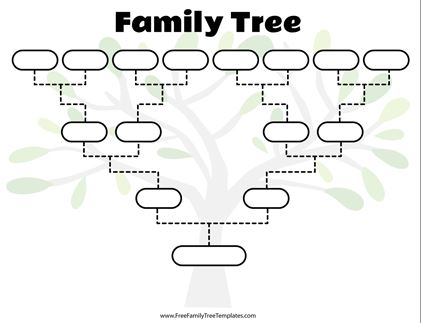
A “descendant” tree starts with a person and works forward in time, showing their children, grandchildren and so on. This is more difficult to chart due to the variable number of children at each generation.
Two common numbering systems used to display descendants of a given ancestor are the NGSQ Numbering System and the Register Numbering System. The Ahnentafel Numbering System is the most popular numbering system for ascending genealogies.
Ahnentafel Numbering System
Ahnentafel is German for “ancestor table”. It uses a strict numbering system to list all the ancestors of a particular individual, as shown in the following diagram.
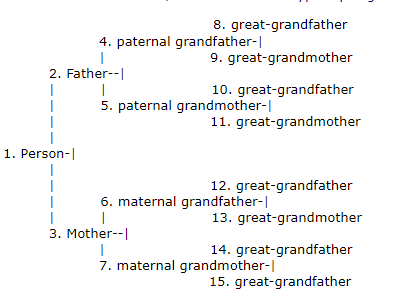
The information written in ahnentafel format, would be as follows, and would also include the full name of each person as well as dates and places of birth, marriage, and death whenever possible.
1 Subject
2 Father
3 Mother
4 Father’s father
5 Father’s mother
6 Mother’s father
7 Mother’s mother
8 Father’s father’s father
9 Father’s father’s mother
10 Father’s mother’s father
11 Father’s mother’s mother
12 Mother’s father’s father
13 Mother’s father’s mother
14 Mother’s mother’s father
15 Mother’s mother’s mother
Some of the family history software programs, for example, Legacy will create an Ahnentafel (Ancestor) Report from your family tree.
NGSQ Numbering System
The NGSQ Numbering System originates from the National Genealogical Society Quarterly published by the National Genealogical Society.
The most significant difference between the NGSQ and the Register Systems is in the method of numbering for children who are not carried forward into future generations: The NGSQ System assigns a number to every child, whether or not that child is known to have progeny, and the Register System does not.
(–Generation One–)
1 Progenitor
- 2 i Child
3 ii Child (no progeny)
4 iii Child (no progeny) - 5 iv Child
(–Generation Two–)
2 Child
6 i Grandchild (no progeny)
7 ii Grandchild (no progeny)
5 Child - 8 i Grandchild
(–Generation Three–)
8 Grandchild - 9 i Great-grandchild
10 ii Great-grandchild (no progeny) - 11 iii Great-grandchild
- 12 iv Great-grandchild
Register Numbering System
The Register System uses both common numbers (1, 2, 3, 4) and Roman numerals (i, ii, iii, iv). The system is organised by generation and generations are grouped separately.
(–Generation One–)
1 Progenitor
2 i Child
ii Child (no progeny)
iii Child (no progeny)
3 iv Child
(–Generation Two–)
2 Child
i Grandchild (no progeny)
ii Grandchild (no progeny)
3 Child
4 i Grandchild
(–Generation Three–)
4 Grandchild
5 i Great-grandchild
ii Great-grandchild (no progeny)
6 iii Great-grandchild
7 iv Great-grandchild